
Life in Thailand is fast-paced right now. Work demands most of my energy and time, and I simply cannot afford long gym sessions, complicated routines, or drawn-out recovery protocols. But I still want to stay in shape, mentally sharp, and physically ready. That’s why I’ve designed a minimalistic training plan.
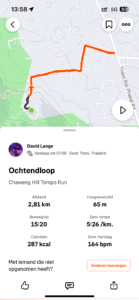 The foundation of the plan is a short, consistent run that I do first thing in the morning. I don’t delay with brushing my teeth, making coffee, or taking supplements. I wake up and run. The route is always the same: The Chaweng Hill 2.8 kilometers, with the first half being downhill and the second half returning uphill. The total duration is short, which makes it sustainable to do almost every day, but the effort can vary significantly based on how I approach it.I follow a three-day rotation. Day one is a max-effort run, where I aim to push my limits and see how fast I can complete the Chaweng Hill. It is intense, especially during the final uphill segment. Day two is a controlled Zone 2 run, which functions as active recovery for the first day. I keep my heart rate around 145 bpm and focus on breathing. Day three is a walking session. This serves as a full recovery while still maintaining the habit and rhythm of morning movement.
In addition to the running cycle, I incorporate push-ups into my workday. After every 50-minute work block, I do sets of 10 push-ups. I continue doing sets of 10 throughout the day, as long as I can maintain perfect form. The moment I can no longer complete a clean set of 10, I stop for the day. This approach prevents overtraining and allows for high-frequency volume without burning out. I repeat the 3-day cycle and push-up regimen six days per week and take one full rest day to allow for deeper recovery.
This method of spreading sub-maximal effort across the day is known as “greasing the groove.” It focuses on building neuromuscular efficiency and endurance through frequent practice without inducing significant fatigue. It’s a highly effective way to build strength in bodyweight movements like push-ups, especially when time and equipment are limited.
What makes this training plan work is that it respects the realities of my schedule. It requires no equipment, no travel time, and no guesswork, no excuses. It balances intensity with recovery and incorporates both strength and cardiovascular conditioning. Most importantly, it is sustainable. I never have to wonder whether I will have time to train. I simply wake up and do the work.
In a period of life where time is the limiting factor, simplicity is a competitive advantage. This plan gives me structure, discipline, and daily momentum. It might not be flashy, but it keeps me fit, focused, and functional.
If you are short on time and want to maintain your physical capacity without complicating your life, a minimalistic training plan like this might be exactly what you need.
The barrier to fitness and general health doesn’t have to be high, just get started with the basics.